With Maria needing some peace and quiet to get a report done I decided it was about time to dust off the old push-bike and go for a ride in the rain. Even better, I could combine it with a visit to the folks' house (about a 16 mile round trip) rather than going in the car as usual.
Bicycles make excellent platforms for nature spotting, as you glide silently along quiet country lanes you never know what you might surprise around the next corner. They also get you access onto off-road cycle paths which often go through more natural areas and along river banks.
Nothing particularly exciting on the nature front today, although I did have a close call with a stand of giant hogweed (Heracleum mantegazzianum - now that's a proper scientific name!) as I pedalled alongside the River Calder on my way back.
This non-native plant is not only highly invasive, rapidly spreading by generating thousands of seeds, it is also hazardous to human health. It contains chemicals within its sap that cause painful, light sensitive skin blisters, which can persist for months or even years after initial contact.
So please be careful if you come across this beast of a plant - admire it from a distance!
And don't forget - you can record it's location using the excellent Plant Tracker app on your phone. Help scientists understand how far it has spread and figure out what we might be able to do about it.
What is 30 Day Wild - find out here!

Ecologists, conservationists and habitat managers; our most interesting antics will be posted here:
Sunday, 14 June 2015

Saturday, 13 June 2015
30 Days Wild - Day 13: Coming home to roost
A new "house bird" to add to the tally; whilst taking a well earned rest on the bench in the back garden this evening, I spotted a blue tit going into the house sparrow box (which the house sparrows have yet to take up - don't they read the books?!).
It went in there to roost for the night, maybe it'll decide to nest in there one day....

Friday, 12 June 2015
30 Days Wild: Day 12 - Good weather for....... newts!
Tonight sees us doing our last great crested newt survey of 2015.
For those who aren't familiar with this highly protected amphibian and its survey requirements; the survey season runs from mid-March to mid-June each year, the breeding season for newts, which sees the adults returning to ponds where they get busy creating the next generation.
We've been spoiled this season with lots of fine weather, so it was only fair that tonight's survey was undertaken in-between rain showers. While it might be a little uncomfortable for us it will be a welcome relief for the amphibians - all this dry weather of late has meant that ponds have been steadily shrinking, so this should top them up nicely. Being mild and damp also gives these porous skinned, cold blooded creatures the best conditions for moving around on land too, as we saw tonight. Once the first shower had begun we started seeing frogs and toads moving around near to the ponds,
followed by several palmate newts which have probably been waiting patiently in the pond for the opportunity to move on.

 They can move surprisingly fast on land considering their small size, especially when they get to open ground.
What is 30 Days Wild? Read all about it here.
For those who aren't familiar with this highly protected amphibian and its survey requirements; the survey season runs from mid-March to mid-June each year, the breeding season for newts, which sees the adults returning to ponds where they get busy creating the next generation.
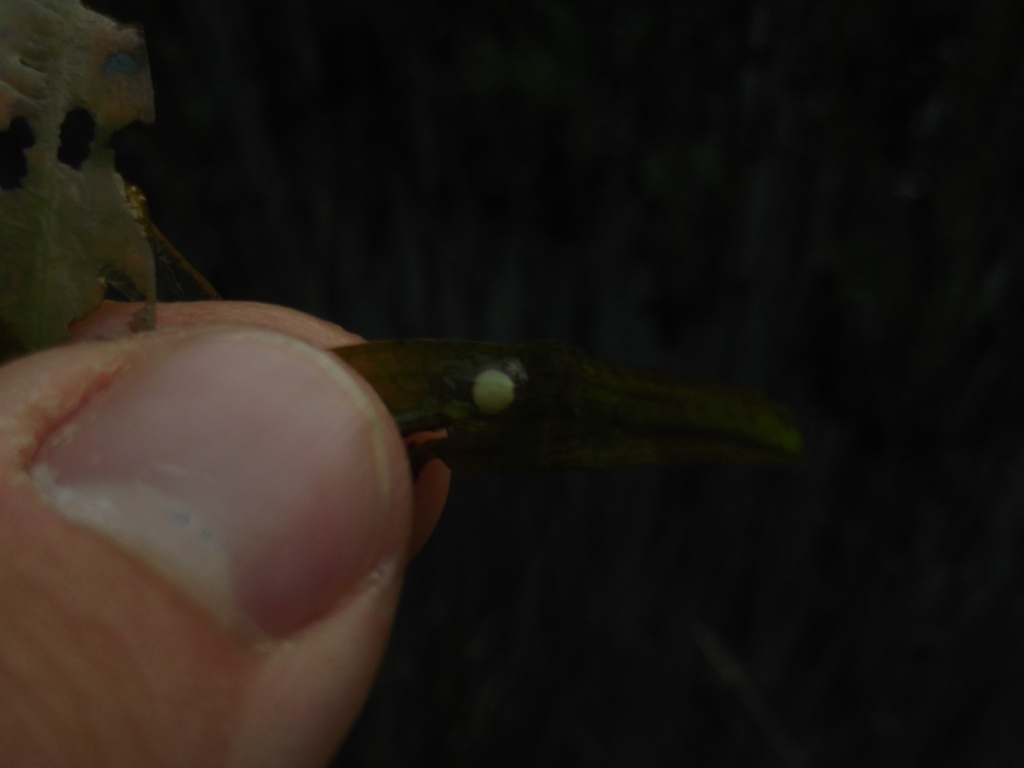 |
| A great crested newt egg - the female lays these on leaves under the water and folds the leaf over it. |
 |
| Common toad on the move |
followed by several palmate newts which have probably been waiting patiently in the pond for the opportunity to move on.


What is 30 Days Wild? Read all about it here.
Thursday, 11 June 2015
30 Days Wild: Day 11 - Up with the lark
This morning we were "up with the lark" to do a breeding bird survey at dawn.
Breeding bird surveys in woodland are mostly done by identifying the calls and song of the birds present, you don't often get to actually see them in the open. Maria is the birder in our outfit, I'm just the apprentice / sherpa!
Most notable birds of the morning were wood warbler, cuckoo and tree pipit (see very distant photo below!).

A bird of woodland edge and grassland with scattered trees, they are similar (and related) to meadow pipit but have a distinctly different call. They call from tree perches and also launch their song flight from these perches as opposed to meadow pipit who tend to launch themselves from the ground/low vegetation.
Breeding bird surveys in woodland are mostly done by identifying the calls and song of the birds present, you don't often get to actually see them in the open. Maria is the birder in our outfit, I'm just the apprentice / sherpa!
Most notable birds of the morning were wood warbler, cuckoo and tree pipit (see very distant photo below!).

A bird of woodland edge and grassland with scattered trees, they are similar (and related) to meadow pipit but have a distinctly different call. They call from tree perches and also launch their song flight from these perches as opposed to meadow pipit who tend to launch themselves from the ground/low vegetation.
Wednesday, 10 June 2015
30 Days Wild: Day 10 - Along for the rode
Tonight we've been on the hunt for woodcock and nightjar which involves a bit of a twist on the standard breeding bird survey, in that it's done at dusk rather than dawn.
No nightjar tonight; the habitat we were surveying is good in places but not extensive. A few woodcock "roding" towards the end of the survey though.
"Roding" basically describes the activity of the male woodcock patrolling along woodland edges and over scrubby areas where there may be female woodcock looking to mate. They perform distinctive squeaking and grunting calls as they do it in an effort to woo the ladies.
Again no photo of the birds in question - woodcock are really tricky to photograph in flight, especially on a phone!
Anyway, must dash off, we'll be back up in a few hours to go and do a normal breeding bird survey at dawn.
No nightjar tonight; the habitat we were surveying is good in places but not extensive. A few woodcock "roding" towards the end of the survey though.
"Roding" basically describes the activity of the male woodcock patrolling along woodland edges and over scrubby areas where there may be female woodcock looking to mate. They perform distinctive squeaking and grunting calls as they do it in an effort to woo the ladies.
 |
| Maria scans the treeline for woodcock - listening out for their distinctive calls |
Anyway, must dash off, we'll be back up in a few hours to go and do a normal breeding bird survey at dawn.
Tuesday, 9 June 2015
30 Days Wild - Day 9: Caught short
After another day stuck indoors it was high time for some motorcycle therapy in the evening sunshine.
So off I went, accompanied by Parkinson Senior on his bike, to some of my favourite local hill-top roads for a gentle pootle around.
I find motorbikes make ideal mobile platforms for bird spotting and quite often find myself riding alongside swallows, swifts and even the occasional sparrowhawk on country roads.
I usually have Maria on the back as my expert bird spotter (the international signal for an interesting bird usually involving several jabs in the ribs followed by furious pointing) but not this time, I was on my own. I had to fit it in around all of the usual observations involved in manoeuvering 220kg of Japanese engineering (plus me) around these scenic country lanes.
But it seems I managed just fine, as I rose over the crest of a particularly quiet moorland road a short eared owl passed over right in front of me at just above head height. What a sight. By the time I'd performed a skillfully executed stop into a nearby gateway to get a closer look it was gone.
I've seen several of these in the winter at local sites but this was my first in the uplands where these fine birds of prey choose to breed in the warmer months.
No photo this time, so you'll just have to take my word for it!
So off I went, accompanied by Parkinson Senior on his bike, to some of my favourite local hill-top roads for a gentle pootle around.
I find motorbikes make ideal mobile platforms for bird spotting and quite often find myself riding alongside swallows, swifts and even the occasional sparrowhawk on country roads.
I usually have Maria on the back as my expert bird spotter (the international signal for an interesting bird usually involving several jabs in the ribs followed by furious pointing) but not this time, I was on my own. I had to fit it in around all of the usual observations involved in manoeuvering 220kg of Japanese engineering (plus me) around these scenic country lanes.
But it seems I managed just fine, as I rose over the crest of a particularly quiet moorland road a short eared owl passed over right in front of me at just above head height. What a sight. By the time I'd performed a skillfully executed stop into a nearby gateway to get a closer look it was gone.
I've seen several of these in the winter at local sites but this was my first in the uplands where these fine birds of prey choose to breed in the warmer months.
No photo this time, so you'll just have to take my word for it!
Monday, 8 June 2015
30 Days Wild - Day 8: Back for more?
Being stuck in the office on such a sunny day is generally quite depressing, until I heard a familiar rustle above the window.....
It seems our resident starlings - who have already fledged one brood this year - are back for a second go in our 1970's roofline.

Every time I look at our increasingly shabby looking wooden fascias and contemplate spending at least two days at the top of a ladder re-painting them, the uPVC fascia leaflet on the doormat does seem very tempting. But then I think about our visiting feathered friends and decide that a bit of leg ache is a small price to pay for the in-office entertainment they provide, on what would otherwise be a rather dreary day of paperwork. The woodwork stays!
It seems our resident starlings - who have already fledged one brood this year - are back for a second go in our 1970's roofline.

Every time I look at our increasingly shabby looking wooden fascias and contemplate spending at least two days at the top of a ladder re-painting them, the uPVC fascia leaflet on the doormat does seem very tempting. But then I think about our visiting feathered friends and decide that a bit of leg ache is a small price to pay for the in-office entertainment they provide, on what would otherwise be a rather dreary day of paperwork. The woodwork stays!
Subscribe to:
Posts (Atom)